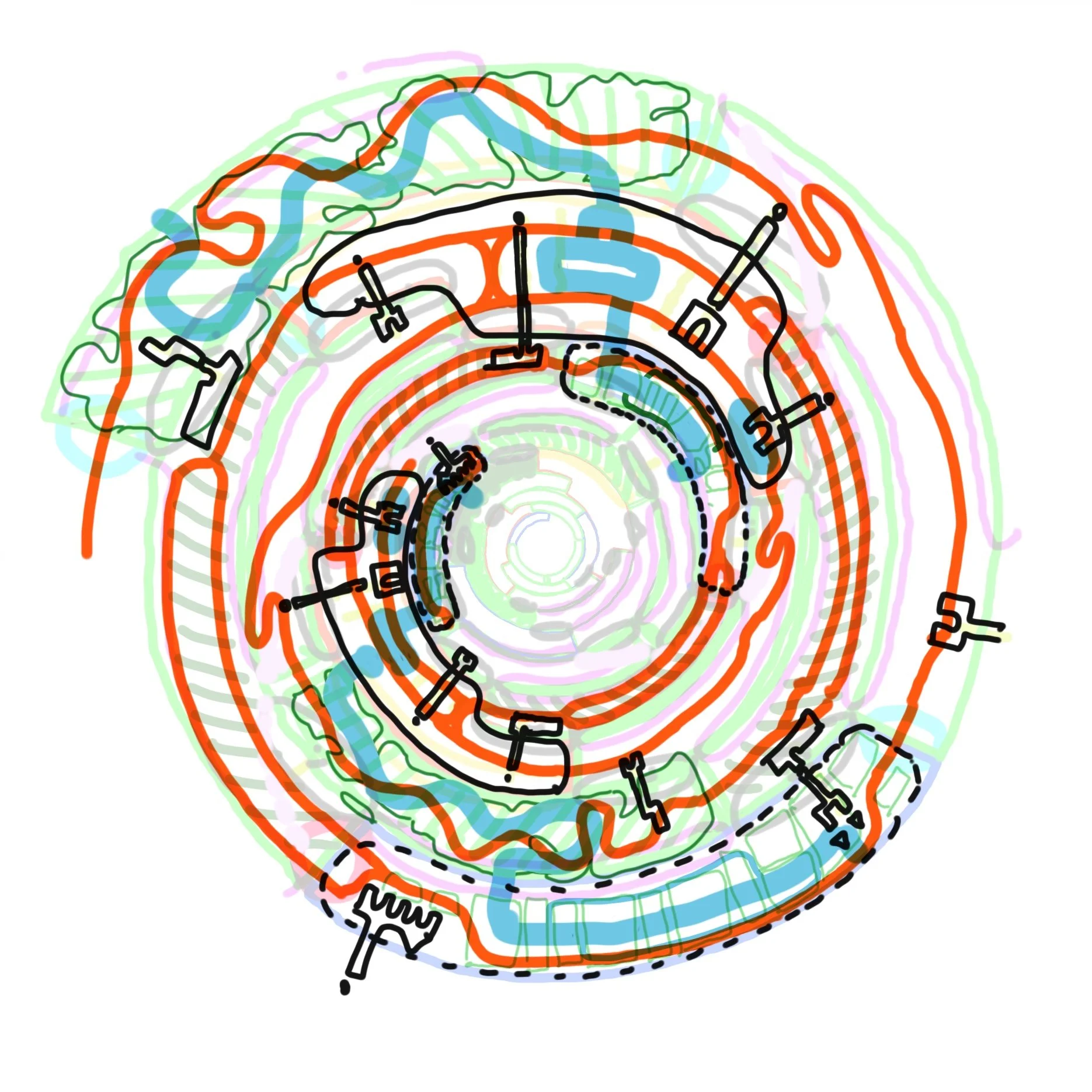
Impossible City 4
-
The repeating nature of the drawn elements that are the basis of each city appeals to me as issues such as the framing and cropping are not established at the start. Even as the final drawing takes shape endless possibilities remain open for how it will be utilised.
Depending on whether it is used at a large or small scale it can either reveal all its detail to tell a story, or create a pure pattern in which the same detail becomes a decorative element, giving a finer grain. Drawn components can be used individually or juxtaposed to create compositions that are effectively abstract.
In each Impossible City the drawing is only the start...
-
…and what could be more constraining than drawing, editing, and assembling every element of an artwork on a screen that is smaller than a single A4 sheet of paper?
I took up the discipline of making art on my iPad because it gives me something that, due to my Parkinson’s, I need - an undo button. This simple feature gives me the power to erase the unwanted graffiti the condition adds to my work without my consent. But, as with every tool that can be used to create an image, the choice of medium brings opportunities and imposes constraints that shape and characterise work made using it.
In the case of the iPad the fundamental restriction is the size of the screen. Looking back at my output since I began working with this tool I have seen the clear influence of this constraint on the form of the images I produce, and I have decided that this is interesting to me and is something I want to explore further.
Many of my projects comprise a set of standard elements that can be assembled in numerous configurations: patterns, tiles, alphabets. These repeating parts combine to form a whole in a process that has parallels with the composition of electronic music in which a rhythmic backbone is established, and then layered with loops and samples. Once an initial version is complete, numerous variations can be spun off from it - there is never a definitive ‘final’ version.
In my imagination I see the screen of my iPad as a small glowing window into a vast parallel space. Each drawn piece that I create must be small enough to pass through this window, so it can join up on the far side with a family of similarly scaled components, to be assembled as patterns, cities, and worlds, expanding in all directions to infinity.
Creating worlds on an 10x8 inch screen
Explore the Impossible Cities

Impossible City 1
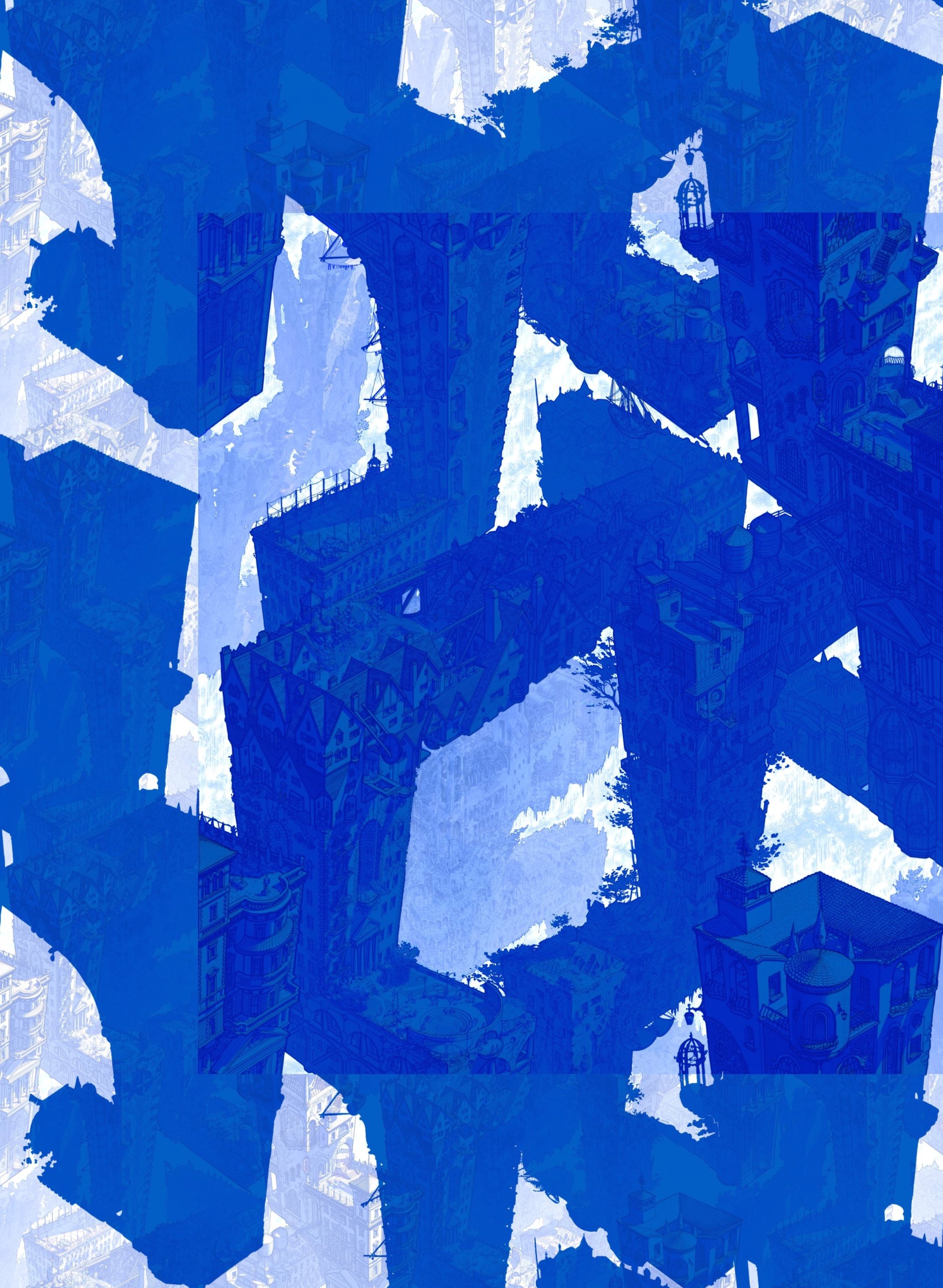
Impossible City 2